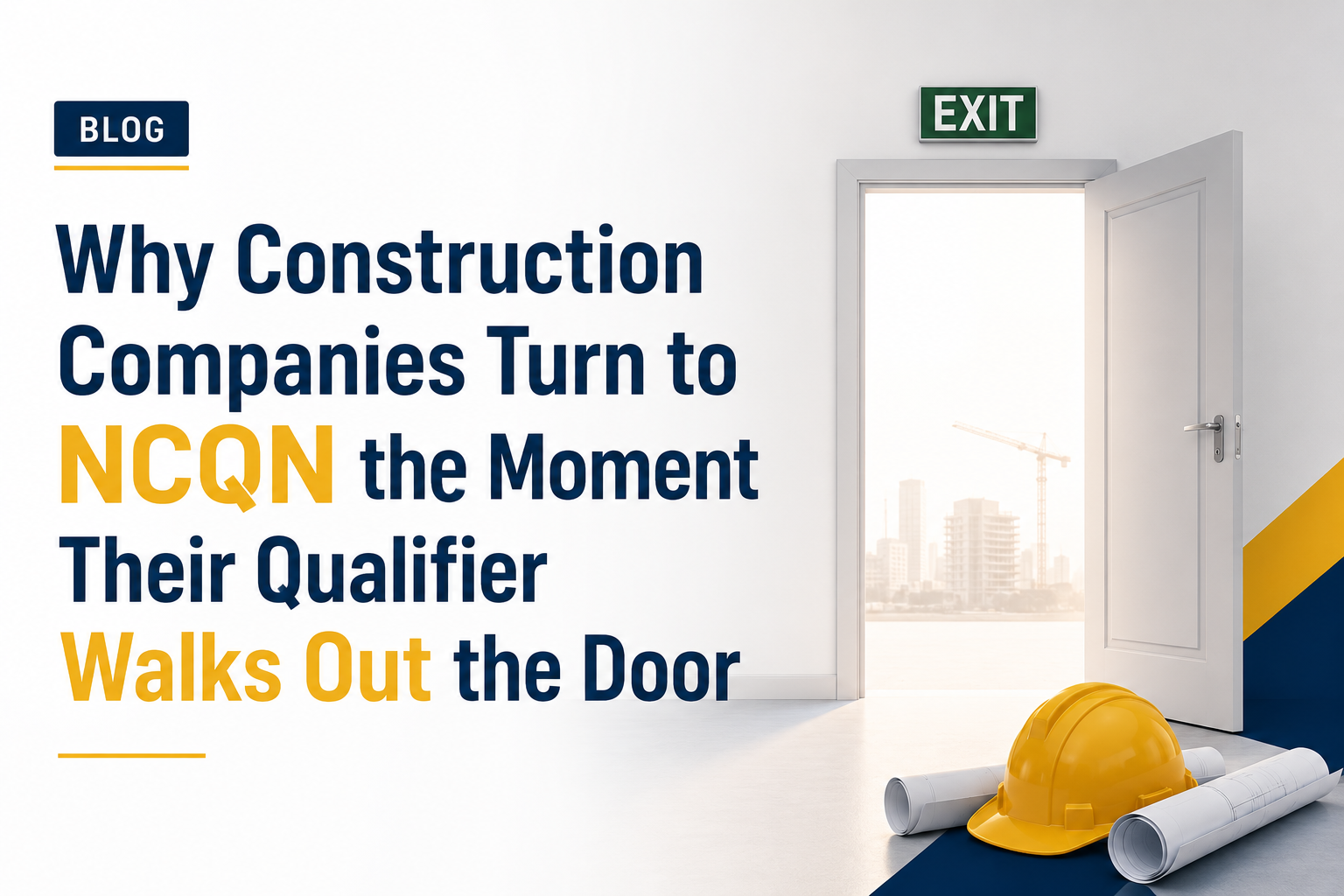
A Qualifier Departure Can Shut Down Operations Overnight
It rarely comes with advance warning. Qualifier replacement for construction companies becomes urgent the moment your qualifying contractor is gone — leaving your license exposed with strict state deadlines already counting down.
Maybe your contractor license qualifier retired unexpectedly. Or a dispute caused an immediate separation. Or the qualifier simply left for another opportunity without giving enough notice. Whatever the reason, the outcome is the same:
- Your company may no longer be able to pull permits
- Active contracts could be at risk
- New licensed work may have to stop immediately
- State licensing boards expect rapid corrective action
That is exactly when construction companies turn to NCQN.
Not after weeks of searching through outdated directories. Not after a bad referral creates even bigger problems. They contact the National Contractor Qualifier Network immediately because the system was built specifically for urgent qualifier replacement situations.
This is not a backup option. It is a purpose-built infrastructure designed for licensing continuity.

What the Replacement Window Actually Looks Like
Most construction companies do not fully understand how quickly the replacement timeline moves until they are already inside it.
The moment a qualifier leaves, the clock starts.
In Florida, the DBPR and Construction Industry Licensing Board enforce strict timelines for replacing a qualifying agent. California’s CSLB closely monitors qualifier designations. Similar expectations exist across North Carolina, Georgia, South Carolina, Alabama, Texas, and many other states.
Most companies are given somewhere between 60 and 90 days to resolve the issue.
At first glance, that may seem manageable. In reality, it disappears quickly once you account for:
- Searching for available qualifiers
- Verifying license standing
- Reviewing complaint history
- Confirming supervision compliance
- Negotiating terms
- Completing state paperwork
During that time, your business may be unable to:
- Pull permits
- Start new licensed projects
- Satisfy contractual licensing obligations
- Maintain uninterrupted operational flow
A licensing gap is not just an administrative issue. It becomes a direct business risk.
Why Informal Referral Channels Fail During Licensing Emergencies
When a qualifier suddenly leaves, most companies instinctively turn to:
- LinkedIn searches
- Industry referrals
- Personal contacts
- Online contractor directories
The problem is not that these resources are useless. The problem is that they are built for networking—not compliance-sensitive licensing emergencies. Informal referrals may provide names, but they rarely provide verification.
Most do not confirm:
- Active contractor license standing
- Board disciplinary history
- Insurance verification
- State-specific supervision obligations
- Regulatory compliance requirements
This creates a dangerous chain of assumptions.
One person trusts another person’s recommendation, who trusted someone else before them. Eventually, nobody has actually verified anything. When your company is facing a lost qualifying contractor replacement situation, relying on unverified assumptions creates enormous exposure. The risks are simply too high.
How NCQN Was Built for Exactly This Situation
Every contractor inside the NCQN network is reviewed against vetted contractor qualifier standards established by the Founding Advisory Board. This is not a superficial screening process. It is the core foundation of the network. Each participating professional undergoes review for:
- License standing verification
- Contractor safety qualification history
- Insurance verification
- State-specific supervision compliance
- Professional conduct standards
The network is also built for speed.
Through Contractor Qualifier Connect and Contractor Qualifier Match, urgent replacement situations have been resolved in as little as 48 hours. Importantly, this is not simply a fast referral system. It is a vetted 48-hour contractor qualifier match process designed to combine urgency with compliance protection.
The NCQN Replacement Process: Step by Step
1. Initial Consultation
The construction company provides:
- State location
- License classification
- Replacement timeline
- Business requirements
2. Network Match Search
Qualifier replacement for construction companies starts with NCQN searching its governed national database for vetted professionals matching your exact licensing needs.
3. Structured Introduction
Once a suitable match is identified, NCQN facilitates a direct introduction between both parties.
4. Independent Negotiation
The company and qualifier negotiate directly regarding:
- Compensation
- Responsibilities
- Supervision expectations
- Contract structure
NCQN does not:
- Control negotiations
- Dictate terms
- Take compensation percentages
The process remains transparent and professional.
5. Licensing Continuity Support
The goal is simple:
Restore compliant licensing coverage quickly while minimizing operational disruption.
Why Speed Without Vetting Creates Bigger Problems
When deadlines are closing in, many companies feel pressure to accept the first available qualifier. That reaction is understandable—but dangerous. A rushed and poorly vetted arrangement can expose your company to risks such as:
- Unresolved board complaints
- Quietly expired licenses
- Improper supervision structures
- Non-compliant qualifying relationships
In some cases, a deficient qualifier arrangement can create more exposure than having no qualifier at all because it creates the appearance of compliance without the legal reality.
NCQN operates on a simple principle: The replacement must happen quickly—but it also must be correct. That balance between speed and verification is what makes the network valuable.
What a Licensing Gap Actually Costs a Construction Company
The financial consequences of a qualifier gap escalate rapidly.
Permit Delays:
Without proper qualifier coverage, permits often cannot be pulled, causing projects to stall.
Contract Exposure
Many contracts require proof of active licensing. A licensing interruption may place agreements into technical default.
Bonding and Insurance Risks
Some bonding and insurance provisions may be triggered when licensing issues occur.
Reputation Damage
Even temporary licensing problems can create long-term reputational concerns with clients, municipalities, and partners. Effective construction risk mitigation means resolving qualifier gaps before they compound into larger operational problems. Compared to the value of active projects and client relationships, rapid qualifier replacement becomes a critical business safeguard.
Why Companies Contact NCQN Immediately
Construction companies that handle qualifier transitions successfully tend to act early. The moment a departure becomes possible, they begin preparing replacement options.
Why?
Because early action provides:
- Better qualifier matches
- More negotiation flexibility
- Reduced project disruption
- Lower compliance risk
- Faster operational stabilization
NCQN is designed to move quickly, but stronger outcomes happen when companies begin the process before deadlines become emergencies.
Don’t Wait Until Projects Are Already at Risk
If your qualifier has already left—or if you know a departure is coming—this is the time to act.
Start the replacement process immediately.
Share:
- The state involved
- The affected license classification
- Your operational timeline
The network is built to move fast because licensing disruptions do not wait.
Conclusion: A Qualifier Departure Is Disruptive—But Solvable
A qualifier departure is one of the most serious licensing disruptions a construction company can face. But disruption does not have to become a disaster. Qualifier replacement for construction companies has never been easier — NCQN ensures you never navigate it alone, through informal referrals, or against a countdown clock without vetted options.
The professionals are screened.
The introductions are governed.
The process is structured to protect your license—not simply fill an empty position.
The companies that recover fastest are the ones that move early, move strategically, and work with infrastructure designed specifically for licensing continuity. Because when the right vetting is already completed before the introduction happens, fast replacement becomes possible without sacrificing compliance.
That is what makes a true 48-hour contractor qualifier match achievable.